





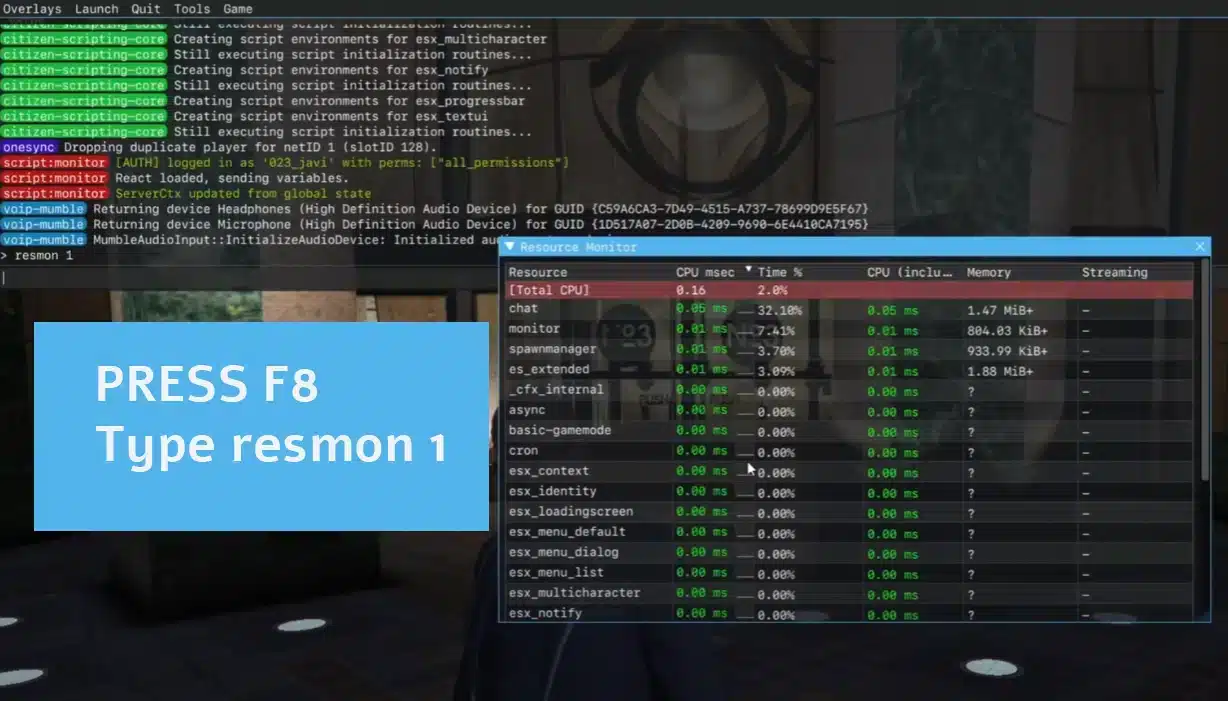
Resmon shows client resource execution cost and memory signals. Use it to identify a script worth investigating, then reproduce the same action with the profiler. It does not measure server database time, download speed or total GPU rendering cost.
The configuration and code examples here target FiveM for GTA V Legacy. Enhanced has different runtime and compatibility rules; check Cfx.re’s Legacy-to-Enhanced changes before applying them to an Enhanced server.
Open and close the monitor
Join your development server, open F8 and run:
resmon trueIf the command is restricted, use a permitted development client as described in the official client-console reference. Do not bypass a public server’s restrictions. To hide the monitor:
resmon falseMake a useful comparison
- Record the client settings, server population, location and resource versions. Begin with a quiet idle scene.
- Perform one repeatable action: open a menu, use a job interaction or enter a vehicle. Note which resource’s timing changes and whether the cost continues after the action ends.
- Repeat the action several times. A short initialization spike has a different cause from continuous idle work.
- On staging, change or stop one suspected resource after checking its dependencies, then repeat the same route and action.
- Keep logs and before/after measurements. Retest a reconnect and full restart before deploying a change.
Investigate the code behind the number
Use the Cfx.re profiler to locate the costly script path. Check repeated NUI messages, unnecessary polling and repeated work inside loops. Increase waits only when the task does not require per-frame execution.
If scripts look inexpensive but FPS remains low, inspect rendering settings, streamed assets and GPU pressure separately. A low Resmon number does not prove that a large map or texture pack is cheap to render.
How should I compare script performance before buying?
Compare the same action, location and client settings. An idle resource-monitor value is not a guarantee for a busy server. Ask for the test conditions behind a benchmark and inspect profiler traces before replacing a resource solely for a lower advertised number.