





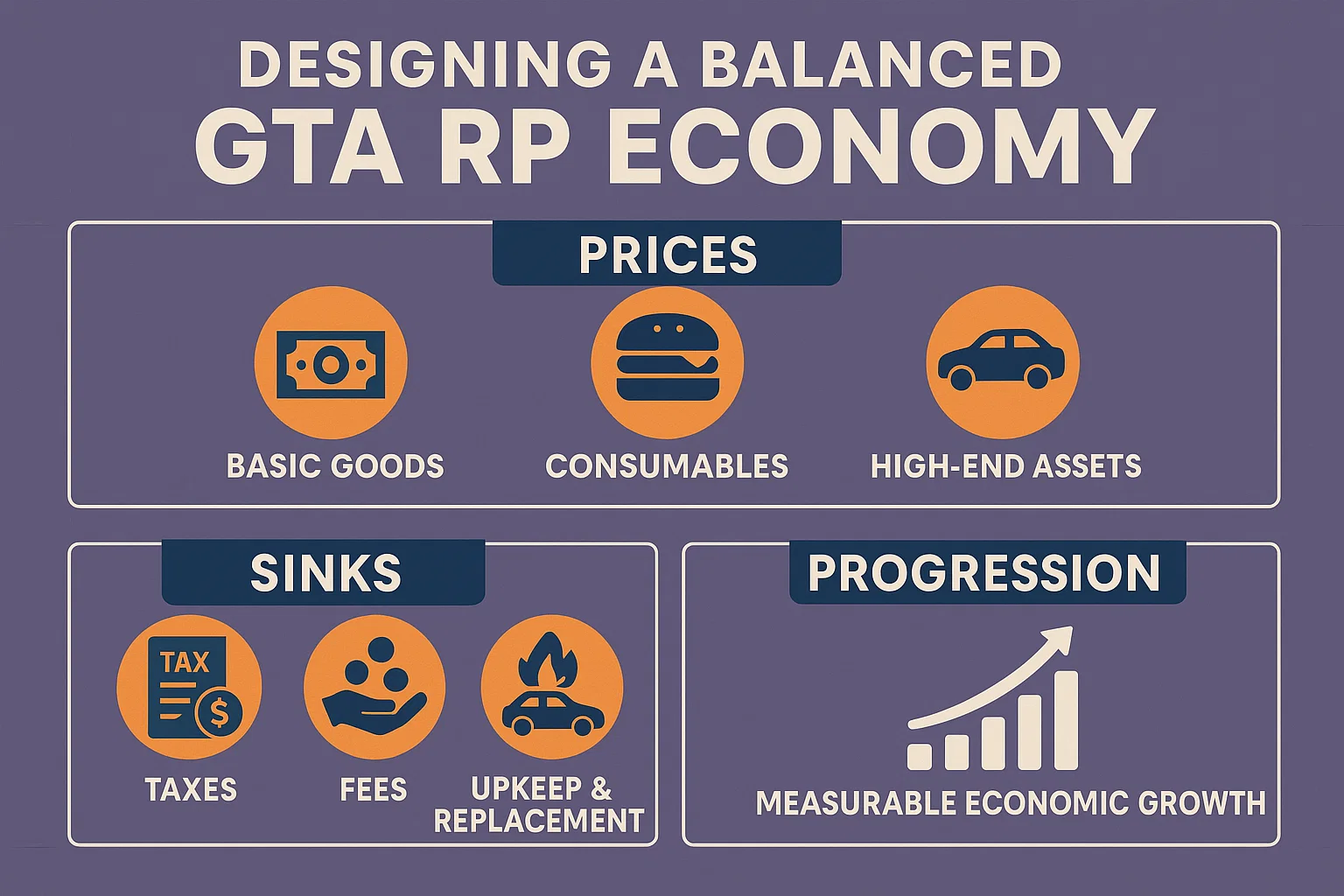
Balance a GTA RP economy around the time and choices you want players to experience. Measure money creation, money removal and progression separately; changing prices without understanding income can make a server feel grindy without fixing inflation.
Define a player milestone
Choose one early goal, such as a basic vehicle plus a repair kit. Decide how many active sessions should reasonably reach it, considering your community’s play style. This is a design choice, not a universal hours target.
For an illustrative example, a character earns 1,000 game-currency units per hour and spends 250 on ordinary supplies. At a net 750 per hour, a 6,000-unit goal takes eight active hours. Include travel, waiting and failed attempts when measuring the actual result.
Separate creation, removal and transfers
A server-paid job creates currency. A purchase from an NPC shop that removes the payment from circulation is a sink. A sale between two players transfers existing money; its gross value is not new currency. Society accounts also need classification by where their money comes from and goes.
Record the source, amount, time and an internal character reference for each relevant flow. Avoid logging more personal information than needed. Reconcile the totals with stored balances and investigate differences before changing prices.
Build a small price and payout sheet
Use columns for action/item, duration, payout or cost, repeat conditions, prerequisites and observed completion time. Keep essentials affordable enough for normal play and place optional progression goals above them.
Compare jobs by actual active time, setup cost and cooperation required. A lucrative activity that can be repeated without meaningful play needs a server-side rule or exploit fix before a price adjustment.
Choose sinks that support play
Repairs, fuel, business supplies and optional customization can create recurring decisions. Explain charges before players commit. Mandatory fees that repeatedly prevent newcomers from participating deserve particular scrutiny.
A player-run business payment may be a transfer rather than a sink. Count only the portion actually removed by the system. Do not assume a fee exists because a sample configuration key has been added; the installed resource must implement it.
Check cohorts and outliers
Compare new and established characters separately. Track time to the first milestone, net creation/removal, the distribution of balances and the activities responsible for large changes. Median player net flow is useful context but does not by itself describe total currency growth.
Observe player feedback alongside the numbers. If most time is spent waiting or repeating one optimal job, a numerically balanced economy can still be tedious.
Change one mechanism at a time
- Back up the affected configuration and data, then test the proposed values on a separate instance.
- Document the expected effect and which player group it should help.
- Check server-side payment validation, repeat limits and persistence with known test actions.
- Publish clear change notes and monitor a comparable period after release.
- Reverse or adjust the specific change if the observed effect differs; do not wipe balances to hide an unresolved accounting problem.
Avoid automatic corrections too early
Dynamic prices or taxes introduce additional behavior to debug. Begin with understandable fixed rules and reliable measurements. Introduce bounded automation only when you can explain its inputs, limits, failure behavior and effect on ordinary players.